As NASA enters a new era of space exploration with the launch of Artemis II in April 2026, attention once again turns to the equipment trusted by astronauts in the most extreme environments imaginable.
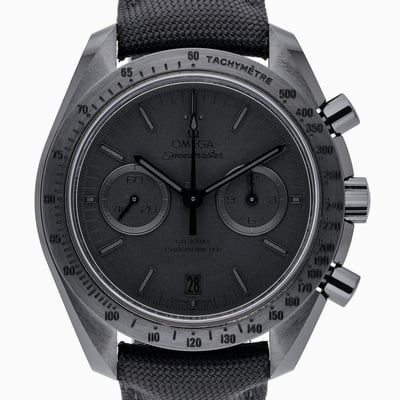
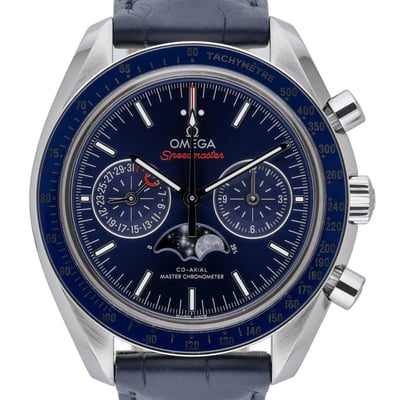
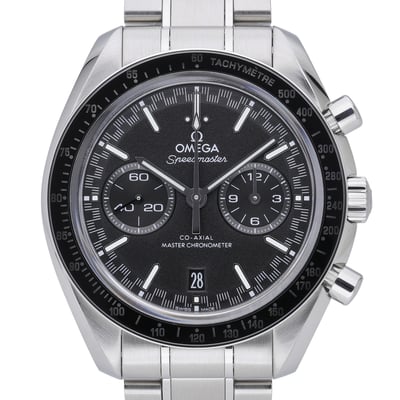
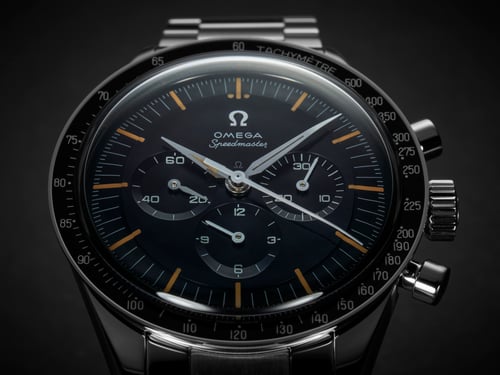
Among the most iconic of these is the Omega Speedmaster - better known as the Moonwatch - a timepiece that has remained a constant throughout decades of space missions.
In 1957, Omega introduced its professional line of watches, consisting of three models that would each go on to achieve legendary status:
The Speedmaster
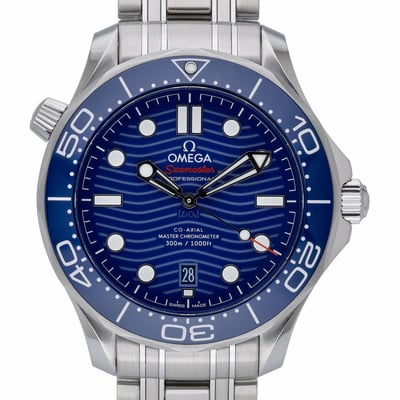
The Seamaster 300
The Railmaster
While all three became icons, the Speedmaster would ultimately carve out a unique place in history - beyond Earth itself.
Nearly three years before NASA qualification, astronaut Wally Schirra wore his personal Omega Speedmaster CK2998 on Mercury‑Atlas 8 ‘Sigma 7’ (3 October 1962), completing six Earth orbits over 9 hours, 13 minutes, 11 seconds - marking the first Speedmaster in space.
Schirra later became one of the few astronauts to fly Mercury, Gemini and Apollo missions - further cementing the Speedmaster’s place in NASA operations.
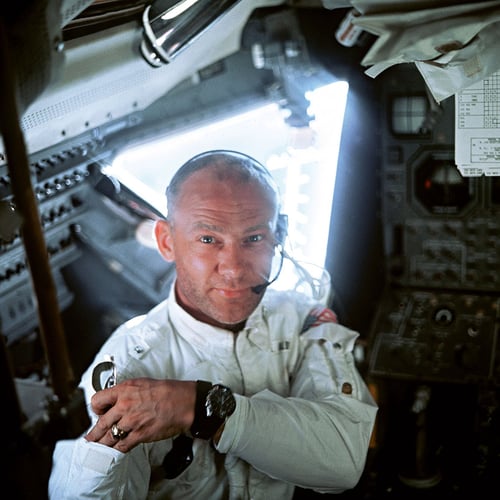
Before official NASA qualification, astronaut Wally Schirra wore his personal Speedmaster chronograph aboard the Mercury Sigma 7 mission in 1962.
During the mission, Schirra orbited the Earth six times over 9 hours, 13 minutes, and 11 seconds.
Across his career, which included Mercury, Gemini, and Apollo missions, he logged a remarkable 295 hours in space - always accompanied by his Speedmaster.
On 21 July 1969 at 02:56 GMT, humans first stepped onto the Moon. Each astronaut wore the Omega Speedmaster Professional as part of their essential equipment. Following Apollo 11, the watch earned its enduring nickname:
The Moonwatch.
The first moonwalk lasted approximately two and a half hours. Over the following three years, ten more astronauts would walk on the lunar surface - each with a Speedmaster strapped over their spacesuit using a Velcro strap.
Launched on 11 April 1970, Apollo 13 became one of NASA’s most dramatic missions after an onboard explosion left the crew stranded.
With limited systems available, astronauts relied on their Speedmasters to manually time a critical 14-second engine burn - essential for safe re-entry.
The mission ended successfully on 17 April after 142 hours and 54 minutes in space, with the Speedmaster playing a vital role in the crew’s survival.
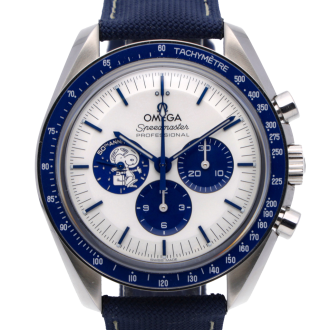
he Omega Speedmaster “Snoopy” Moonwatch is one of the most celebrated variations of the iconic chronograph, created to honour Omega’s role in the safe return of the Apollo 13 mission.
Featuring the famous Snoopy character - NASA’s symbol for mission success - the watch commemorates the Silver Snoopy Award presented to Omega in 1970.
Combining playful design elements with serious historical significance, Snoopy editions have become highly sought-after among collectors and remain a unique tribute to one of space exploration’s most dramatic moments.
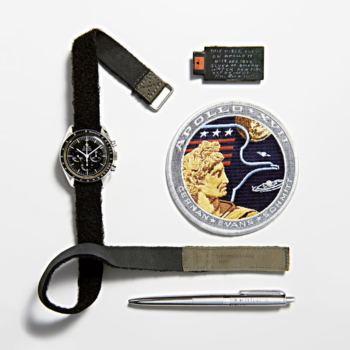
Apollo 17 marked NASA’s final manned mission to the Moon. Commander Eugene Cernan and his team spent over three days on the lunar surface - the longest lunar stay in history. Meanwhile, experiments conducted in orbit also relied on the Speedmaster.
One astronaut even engraved his personal watch with:
“Flows in C.S.M to the Moon”
“Apollo 17”
A rare reminder of the watch’s personal and historical significance.
The Apollo–Soyuz mission in 1975 marked the first docking between American and Soviet spacecraft.
In a symbolic moment during the Cold War, commanders from both nations shook hands in space - each wearing an Omega Speedmaster.
Soon after, the Speedmaster was adopted by the Russian space programme, reinforcing its position as the definitive space watch.
In 1993, a Speedmaster spent an entire year aboard the Russian Mir space station to test its durability in zero gravity.
After approximately 5,840 orbits of Earth, the watch returned in perfect working condition - keeping time as accurately as when it left.
Omega’s role in space exploration has continued into the modern era. In 2022, the brand supported projects focused on sustainability in space:
ClearSpace - Removing dangerous orbital debris
Privateer - Mapping space objects for future missions
These initiatives highlight a shift towards responsible and sustainable exploration.
The Artemis II mission launched on April 1st, 2026, at 22:35:12 (UTC), marking the first human-crewed lunar mission since 1972. While technology has evolved significantly, one thing remains unchanged—the presence of Omega Speedmaster watches as official astronaut equipment.
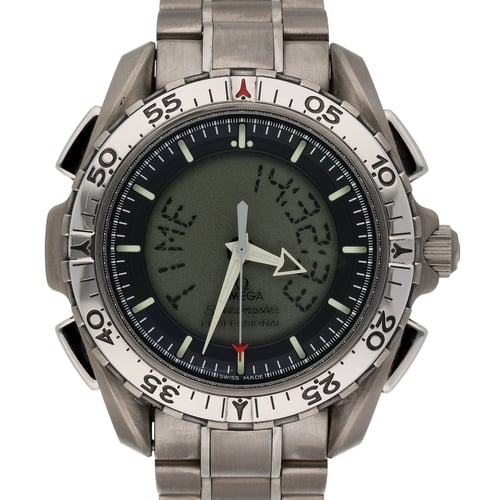
All four NASA astronauts -Commander Reid Wiseman, Pilot Victor Glover, Mission Specialist Christina Koch, and Mission Specialist Jeremy Hansen - are equipped with the Omega Speedmaster X-33 Generation 2 (ref. 3291.50.00).
Originally developed with input from NASA General Thomas P. Stafford, the X-33 has been part of space missions since 1998 and is specifically designed for use aboard spacecraft.
The distinction between models remains clear:
Speedmaster X-33 - Used inside the spacecraft
Speedmaster Professional (Moonwatch) - Used for EVA (spacewalks)
Crafted from lightweight Grade 2 titanium, the X-33 is built for precision and functionality in space environments.
Interestingly, although the second-generation X-33 was discontinued for public sale in 2006, production has continued exclusively for NASA. The NASA-issued version carries the reference 318.90.45.79.01.001, making it highly sought-after among collectors.
A Historic First
While the Speedmaster Professional defined the Apollo era, Artemis II marks the first time the Speedmaster X-33 is heading towards the Moon.
It represents a modern evolution of a historic tool - bridging heritage with the future of space exploration.
From the earliest space missions to today’s Artemis programme, the Omega Speedmaster has remained a constant.
It has served as:
A mission-critical instrument
A trusted companion in extreme conditions
A symbol of human achievement
As space exploration enters a new era, the Speedmaster continues to prove its relevance - both as a tool and as an icon.