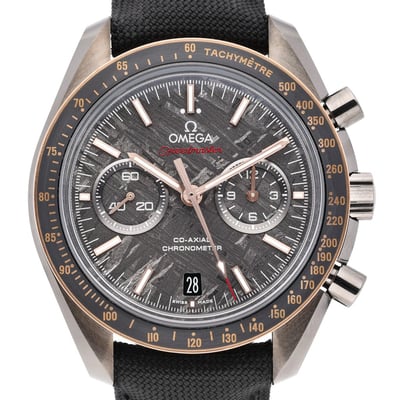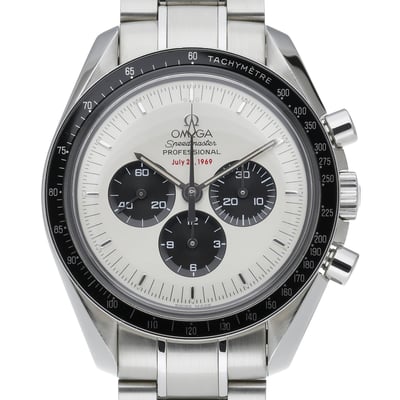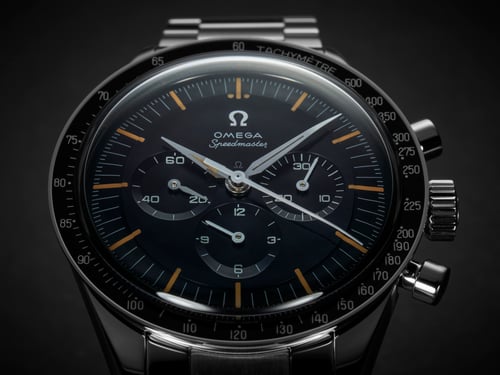
NASA’s latest launch in April 2026 marks another major step forward in space exploration, continuing a journey that began over half a century ago. While rockets, spacecraft, and technology have evolved dramatically, one constant has remained on the wrists of astronauts - the Omega Speedmaster.
Known as the “Moonwatch,” its legacy is inseparable from NASA’s greatest missions, from the first orbit to the Moon landings and beyond.
In 1957, Omega introduced its professional line of watches, consisting of three models that would each go on to achieve legendary status: the Speedmaster, the Seamaster 300, and the Railmaster. While all three served distinct purposes, it was the Speedmaster that would soon find itself at the forefront of human space exploration.
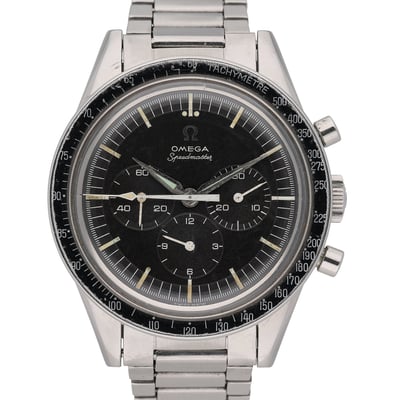
Nearly two and a half years before NASA officially qualified the Speedmaster, astronaut Wally Schirra took his personal Omega Speedmaster chronograph into space aboard the Mercury Sigma 7 mission in 1962.
At a time when space exploration was still largely untested, Schirra chose to wear the watch for its reliability and precision. During the mission, he orbited the Earth six times over 9 hours, 13 minutes, and 11 seconds—marking the first time a Speedmaster had been worn in space.
Schirra later became one of the few astronauts to fly in the Mercury, Gemini, and Apollo programmes, accumulating a total of 295 hours in space. On every mission, he was accompanied by his Omega Speedmaster, proving its capability long before it received official NASA qualification.
As NASA’s space programme intensified in the mid-1960s, the need for a reliable, mission-ready wristwatch became essential.
Omega was one of four watch brands invited to submit chronographs for official testing, entering a process that would ultimately define the future of space-approved equipment. What followed was a series of extreme trials designed to replicate the harsh conditions of space, with each watch exposed to intense heat and cold, heavy shocks, vibrations, and vacuum environments - pushing them to their absolute limits.
One by one, the watches failed, until only a single model continued to perform with complete precision and reliability: the Omega Speedmaster. In 1965, it was officially qualified by NASA as the only watch suitable for all manned space missions and Extravehicular Activity (EVA), securing its place as a vital tool in space exploration.
On 21 July 1969 at 02:56 GMT, humans first stepped onto the Moon in one of the most defining moments in history.
As part of their essential equipment, each astronaut wore the Omega Speedmaster Professional - a watch that would soon earn its enduring nickname, the “Moonwatch.” The first moonwalk lasted approximately two and a half hours, during which astronauts collected samples and carried out experiments on the lunar surface.
In the three years that followed, ten more astronauts would walk on the Moon, each with a Speedmaster securely strapped over their spacesuit using a Velcro strap, reinforcing its role as a trusted tool in space exploration.
Launched on 11 April 1970, Apollo 13 became one of NASA’s most dramatic missions after an onboard explosion left the crew stranded.
With limited systems available, astronauts relied on their Speedmasters to manually time a critical 14-second engine burn - essential for safe re-entry.
The mission ended successfully on 17 April after 142 hours and 54 minutes in space, with the Speedmaster playing a vital role in the crew’s survival.
As a mark of gratitude for its contributions to the success of human spaceflight missions - and in particular the safe return of the Apollo 13 crew - Omega was presented with the Silver Snoopy Award in 1970.
This prestigious honour, awarded by NASA astronauts, consists of a sterling silver lapel pin and certificate, and represents one of the highest distinctions given within the space programme.
Snoopy was chosen as the award’s mascot for his ability to bring a sense of calm and optimism to serious situations. According to NASA, Snoopy was intended to “emphasise mission success and act as a watchdog.”
Today, this historic award is proudly displayed at the Omega Museum in Biel/Bienne, Switzerland.
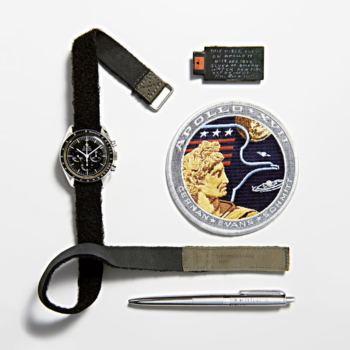
Apollo 17 marked NASA’s final mission to the Moon and remains one of the most significant in the programme’s history. Commander Eugene Cernan and his team spent over three days on the lunar surface - the longest manned lunar stay - conducting extensive exploration and scientific work.
At the same time, experiments carried out in lunar orbit also relied on the Omega Speedmaster, highlighting its continued importance beyond the surface missions. The watch remained a trusted tool in both extreme environments, reinforcing its role throughout the Apollo era.
One crew member even engraved his personal Speedmaster, creating a rare, privately owned piece of space history, with the words:
“Flows in C.S.M to the Moon”
“Apollo 17”
The Apollo–Soyuz mission in 1975 marked the first docking between American and Soviet spacecraft.
In a symbolic moment during the Cold War, commanders from both nations shook hands in space - each wearing an Omega Speedmaster.
Soon after, the Speedmaster was adopted by the Russian space programme, reinforcing its position as the definitive space watch.
In 1993, an Omega Speedmaster was sent aboard the Russian Mir space station for an extraordinary endurance test, spending a full 365 days in orbit. The purpose of the mission was to evaluate the effects of prolonged exposure to zero gravity and the harsh conditions of space on the watch’s performance.
Over the course of its journey, the Speedmaster completed approximately 5,840 orbits of the Earth, enduring continuous weightlessness, temperature fluctuations, and the demanding environment of long-duration spaceflight.
Remarkably, at the end of its year-long stay, the watch was found to be in perfect working order - keeping time just as accurately as it had on the day its voyage began, further proving its reliability in even the most extreme conditions.
Omega’s role in space exploration has continued into the modern era. In 2022, the brand supported projects focused on sustainability in space, including ClearSpace, which aims to remove dangerous orbital debris, and Privateer, a project dedicated to mapping space objects and improving the safety of future missions. Together, these initiatives highlight a clear shift towards more responsible and sustainable space exploration.
The Artemis II mission launched on April 1st, 2026, at 22:35:12 (UTC), marking the first human-crewed lunar mission since 1972. While technology has evolved, one constant remains - the presence of Omega Speedmaster watches as official astronaut equipment.
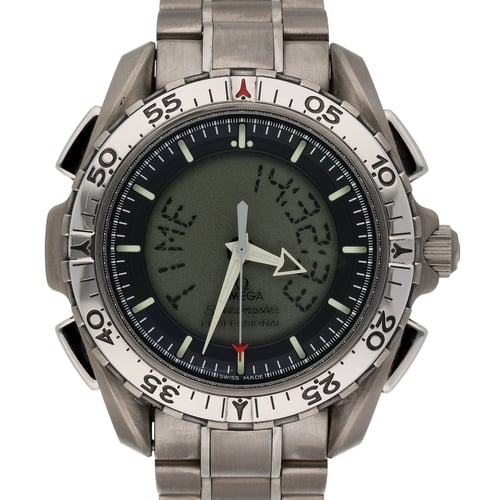
All four NASA astronauts - Commander Reid Wiseman, Pilot Victor Glover, Mission Specialists Christina Koch and Jeremy Hansen - are equipped with the Omega Speedmaster X-33 Generation 2 (ref. 3291.50.00).
Developed in collaboration with American and European astronauts, as well as professional pilots, the X-33 has been used in space missions since 1998 and is specifically designed for use aboard spacecraft. It features a range of specialised functions tailored to mission requirements and space-related experiments, including:
Mission Elapsed Time (MET): A long chronograph function used to measure mission duration in days, hours, minutes, and seconds, forming the basis of all flight operations
Mission Elapsed Time Alarm: Programmable at any point during the mission
Universal Time (GMT):Used as a second time zone
Universal Time Alarm: Alarm function based on GMT or a second time zone
Alongside it, the Speedmaster Professional (Moonwatch) continues to serve during EVA (spacewalks):
Speedmaster X-33: Used inside the spacecraft
Speedmaster Professional:Used for EVA
Crafted from Grade 2 titanium, the X-33 offers precision and durability in extreme conditions. Although discontinued for public sale in 2006, it is still produced exclusively for NASA, with the issued model carrying the reference 318.90.45.79.01.001.
As NASA moves into its next chapter with Artemis II, the Omega Speedmaster continues to be part of that journey. From the first Moon landing to today’s missions, it’s stayed a constant - evolving where needed but never losing what made it so reliable in the first place. Whether it’s the classic Moonwatch or the more technical X-33, it’s a watch that’s proven itself time and time again in space. And if that history means something to you, models like the Omega Speedmaster Moonwatch and even the Snoopy editions are well worth exploring within a range of pre-owned pieces.