The BQ Watches Pre-Owned Market Index - Q1 2026

In one paragraph

The first quarterly edition of the BQ Watches Pre-Owned Market Index, pooling January, February and March 2026 transactional data, introducing the BQ Watches Transaction Price Index and reference-level analysis for the first time.

The first quarterly edition of the BQ Watches Pre-Owned Market Index pools January, February and March 2026 transactional data. Pre-owned Rolex turnover at BQ Watches ran at approximately half its prior-year pace across the quarter, with the median days-to-sell falling to 46 days against 105 days in Q1 2025 and 90 days in Q1 2024. The Rolex GMT-Master "Pepsi" reference 126710BLNR was the most-traded specific Rolex reference in the quarter. The BQ Watches Transaction Price Index, debuting in this edition with Q1 2024 = 100, shows the Rolex Datejust trading at index 123 in Q1 2026 — approximately 23 points above its 2024 baseline — while the Rolex Daytona traded at index 74, approximately 26 points below.

Headline findings

Pre-owned Rolex turnover ran at approximately half its prior-year pace across the full quarter. The median days-to-sell across all Rolex transactions at BQ Watches in Q1 2026 was 46 days, compared to 105 days in Q1 2025 and 90 days in Q1 2024. The pooled-quarter reading confirms what the three monthly editions of the index reported individually: the acceleration in pre-owned Rolex turnover at BQ Watches that began the year is a sustained quarter-long pattern, not the artefact of any single month, and is the strongest opening-quarter Rolex liquidity reading in BQ Watches' record.

The BQ Watches Transaction Price Index debuts in this edition. The index reports the median transacted sale price for each Rolex reference family, indexed against the Q1 2024 baseline = 100, for families that meet the suppression threshold in all three comparison quarters. In Q1 2026, the Rolex Datejust traded at index 123 — the strongest reading among the major Rolex family lines — while the Rolex Daytona traded at index 74. The Rolex Submariner held broadly steady at index 106, and the Rolex GMT-Master at index 99. The Transaction Price Index is published only in quarterly and annual editions; monthly editions do not include it.

The Rolex GMT-Master "Pepsi" reference 126710BLNR was the most-traded specific Rolex reference of the quarter. Reference-level analysis at threshold becomes possible at the quarterly resolution where the larger pooled sample supports it; the GMT-Master 126710BLNR led a Q1 2026 most-traded references list that also included the Submariner Date 126610LN, the Datejust 126334, the Submariner 126610LV ("Starbucks"), the Datejust 126300, and the vintage two-tone Datejust 16233. This is the first edition of the index series to publish reference-level findings.

All eight major Rolex reference families met the suppression threshold in Q1 2026 — the Datejust, Submariner, GMT-Master, Daytona, Sea-Dweller, Oyster Perpetual, Sky-Dweller and Yacht-Master — supporting the most comprehensive Liquidity Report the index has produced to date. In the monthly editions, only three to five families met the threshold per month; the quarterly pooling enables the full sport-and-dress family span.

Tudor brand share continued its multi-year decline at BQ Watches. Tudor accounted for approximately 5% of Q1 2026 transactions, down from approximately 5% in Q1 2025 and approximately 5–10% in Q1 2024 (rounded). At the unrounded level, the share has fallen across three consecutive opening quarters from approximately 6.4% to approximately 4.5% to approximately 2.5%. This is the first edition of the index in which the Tudor share trajectory is published; the storyline was tracked privately across the monthly editions because Tudor consistently fell below the suppression threshold in any individual month.

Generative AI search recorded its first attribution in the BQ Watches customer-acquisition mix in Q1 2026. The single ChatGPT-attributed transaction reported in the March 2026 monthly edition sits below the suppression threshold for metric publication but is preserved here as a quarter-defining qualitative milestone. The next quarterly edition will track whether ChatGPT or any other named generative AI source meets the index suppression threshold across Q2 2026.
Recap of the Q1 2026 monthly editions

The first quarterly edition pools the data behind three monthly editions that have already been published as standalone records. For full month-by-month detail, the monthly editions remain the canonical source.

January 2026 edition: the inaugural edition, reporting the median days-to-sell for a pre-owned Rolex falling from 103 days in January 2025 to 50 days in January 2026, the Rolex Submariner as the fastest-moving Rolex family at 36 days, and the first month in BQ Watches' record in which bqwatches.com overtook the telephone as the leading customer contact channel.

February 2026 edition: the second edition, reporting the acceleration in pre-owned Rolex turnover deepening to a 41-day median, the Rolex GMT-Master as the fastest-accelerating family of the month at 33 days median (down from 134 in February 2025), and the website-overtakes-telephone crossover narrowing to within a percentage point as the telephone narrowly retook the lead.

March 2026 edition: the third edition, reporting BQ Watches' first ChatGPT-attributed transaction, the introduction of the published stock-route composition dimension at approximately 30% consignment-route, the Rolex Daytona's first at-threshold appearance in 2026 with a composition-influenced 1-day median, and a partial reversal of in-person showroom contact growth.

Brand mix at BQ Watches, Q1 2026

Across the full quarter, the brand composition of BQ Watches' completed sales settled into a pattern broadly consistent with Q1 2024 and modestly Rolex-heavier than Q1 2025.

  • Rolex: ~60% of transactions
  • Omega: ~10%
  • Cartier: ~5%
  • Breitling: ~5%
  • Tudor: ~5%
  • All other brands combined: ~15%

Brand share rounded to the nearest 5%. Only brands that met the BQ Watches Pre-Owned Market Index suppression threshold across the full quarter are named individually.

The most notable brand-level shift across the year-on-year comparison is Tudor, where the published share has declined from approximately 5–10% in Q1 2024 to approximately 5% in Q1 2026 (rounded), continuing a multi-year softening of Tudor share at BQ Watches. Cartier held its position as the third-most-traded brand by share for the third consecutive opening quarter.

Most-traded Rolex reference families, Q1 2026

The full Liquidity Report at family level becomes possible at quarterly resolution. All eight major Rolex reference families met the suppression threshold in Q1 2026, ranked by transaction share within Rolex:

  1. Rolex Datejust
  2. Rolex Submariner
  3. Rolex GMT-Master
  4. Rolex Daytona
  5. Rolex Sea-Dweller
  6. Rolex Oyster Perpetual
  7. Rolex Sky-Dweller
  8. Rolex Yacht-Master

The Datejust's top rank holds at quarterly resolution, accounting for approximately three in ten Rolex transactions across Q1 2026. The Submariner consolidates second place with approximately one in five Rolex transactions; the GMT-Master takes third. The Sea-Dweller's quarterly position above threshold (which it held only fleetingly in February and not at all in January or March monthly editions) reflects how quarterly pooling clarifies family-level activity that month-to-month sample sizes cannot.

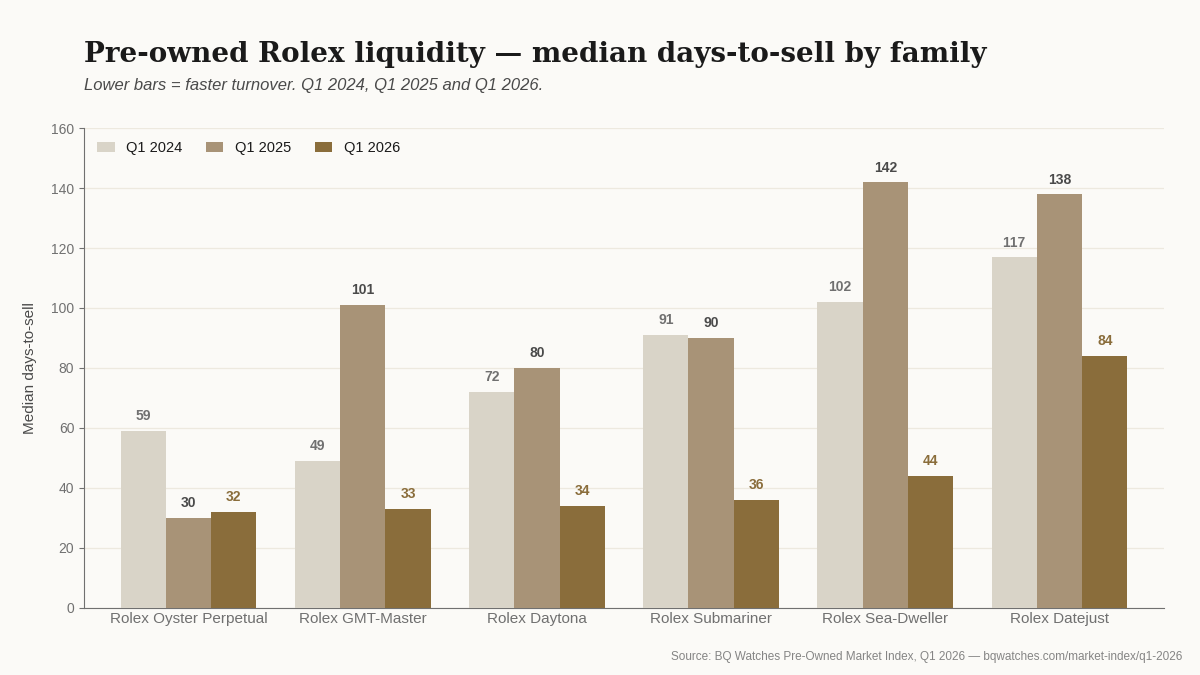
Pre-owned Rolex liquidity by reference family - Q1 2026

Reference family Median days-to-sell, Q1 2026 Median days-to-sell, Q1 2025 Median days-to-sell, Q1 2024 Direction (vs Q1 2025)
Rolex Oyster Perpetual 32 30 59 Broadly stable
Rolex GMT-Master 33 101 49 Faster
Rolex Daytona 34 80 72 Faster
Rolex Submariner 36 90 91 Faster
Rolex Sea-Dweller 44 142 102 Faster
Rolex Sky-Dweller 50 n/a (Q1 2025 and Q1 2024 below threshold)
Rolex Yacht-Master 54 35 Slower
Rolex Datejust 84 138 117 Faster
All Rolex (combined) 46 105 90 Faster

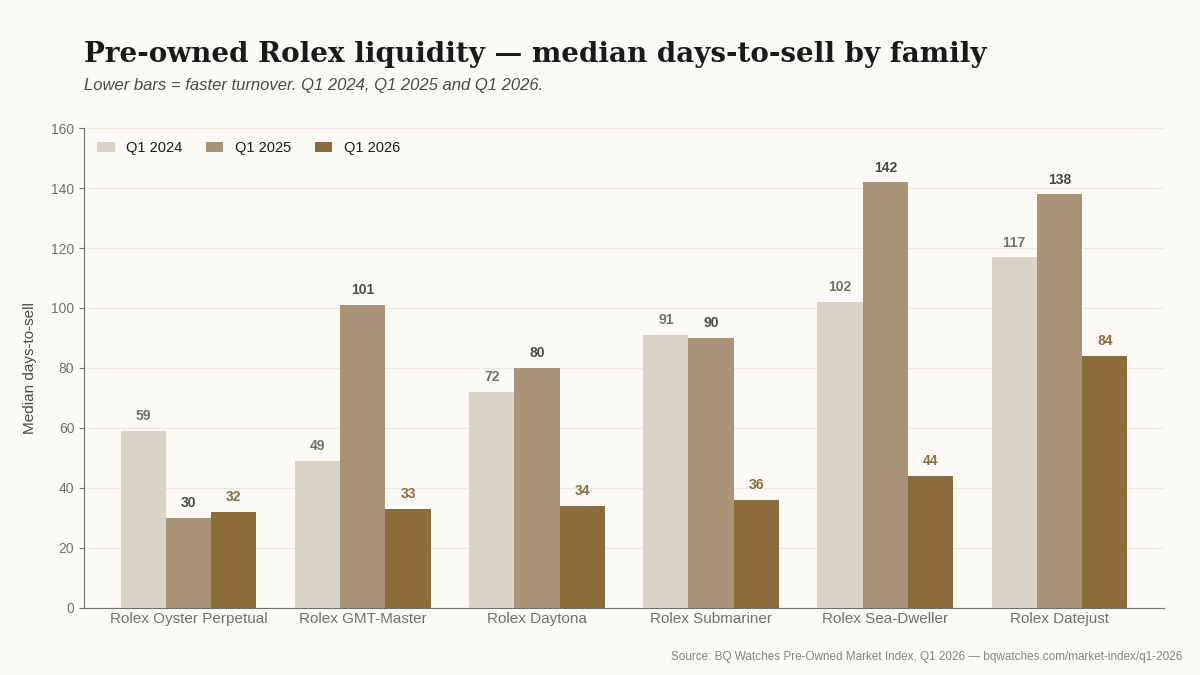
The all-Rolex picture is unambiguous: turnover at BQ Watches ran at approximately half its prior-year pace across Q1 2026. At the family level, the picture is nearly uniformly faster than Q1 2025, with two exceptions: the Rolex Yacht-Master transacted slightly slower than its Q1 2025 reading (which itself was unusually fast), and the Rolex Oyster Perpetual was broadly stable. The Rolex Sky-Dweller appears in the table for the first time in the index series; both Q1 2025 and Q1 2024 had Sky-Dweller volumes below the suppression threshold, so the year-on-year comparison cells are suppressed.

Grouped column chart showing median days-to-sell for six Rolex reference families across Q1 2024, Q1 2025 and Q1 2026. Q1 2026 bars are uniformly the shortest, reflecting acceleration. Datejust 84 days; Sea-Dweller 44; Submariner 36; Daytona 34; GMT-Master 33; Oyster Perpetual 32.
Embed this chart

Copy the snippet below to embed this chart on another page. The chart is published under CC BY 4.0 — please retain the attribution link.

<p><a href="https://www.bqwatches.com/market-index/q1-2026"><img src="https://cdn.bqwatches.com/images/36fc8331-5319-4afc-a7f0-39a2c3efe3ec.png" alt="Grouped column chart showing median days-to-sell for six Rolex reference families across Q1 2024, Q1 2025 and Q1 2026. Q1 2026 bars are uniformly the shortest, reflecting acceleration. Datejust 84 days; Sea-Dweller 44; Submariner 36; Daytona 34; GMT-Master 33; Oyster Perpetual 32." width="1200"></a><br><small>Source: <a href="https://www.bqwatches.com/market-index/q1-2026">BQ Watches Pre-Owned Market Index</a></small></p>
Download chart (PNG)

The chart visualises the Liquidity Report above: across the six Rolex reference families that met threshold in all three comparison quarters, Q1 2026 bars are uniformly the shortest. Sky-Dweller and Yacht-Master are excluded because their Q1 2024 or Q1 2025 sample fell below threshold; see the table for their Q1 2026 values.

Most-traded specific Rolex references in Q1 2026

The quarterly resolution supports reference-level analysis where the suppression threshold is met. The most-traded specific Rolex references at BQ Watches in Q1 2026 are listed below by rank, in order of completed transactions across the quarter:

  1. Rolex GMT-Master 126710BLNR ("Pepsi")
  2. Rolex Submariner 126610LN
  3. Rolex Datejust 126334
  4. Rolex Submariner 126610LV ("Starbucks")
  5. Rolex Datejust 126300
  6. Rolex Datejust 16233 (vintage two-tone, see our reference page for the 16233)

The 126710BLNR's top position reflects the steady UK pre-owned demand for the modern stainless-steel "Pepsi" GMT-Master configuration; the 126610LN's second place reflects the equivalent demand for the standard ceramic-bezel Submariner Date. The presence of the vintage Datejust 16233 in the same list as four current-generation references illustrates the breadth of demand the BQ Watches inventory served across the quarter — vintage two-tone steel-and-gold Datejusts on the Jubilee bracelet remain a UK pre-owned cornerstone alongside the latest sport models. Reference-level findings are published only in quarterly and annual editions; monthly editions do not include them.

The BQ Watches Transaction Price Index

This edition introduces the BQ Watches Transaction Price Index. The index reports the median transacted sale price for each Rolex reference family that met the suppression threshold across each comparison quarter, indexed against the Q1 2024 baseline = 100. The Transaction Price Index is the first published source, to BQ Watches' knowledge, that reports movement in transacted prices in the UK pre-owned luxury watch market — distinct from listing-platform indices such as the WatchCharts Overall Market Index and the Subdial Bloomberg Watch Index, which report movement in asking prices.

Reference family Q1 2024 (baseline) Q1 2025 Q1 2026
Rolex Datejust 100 115 123
Rolex Submariner 100 102 106
Rolex GMT-Master 100 95 99
Rolex Sea-Dweller 100 94 88
Rolex Oyster Perpetual 100 104 100
Rolex Daytona 100 84 74

Index points rounded to the nearest 1. Median sale prices underlying the index are not published in absolute terms, in line with the index series' safe-publishing rules; only the indexed value is reported.

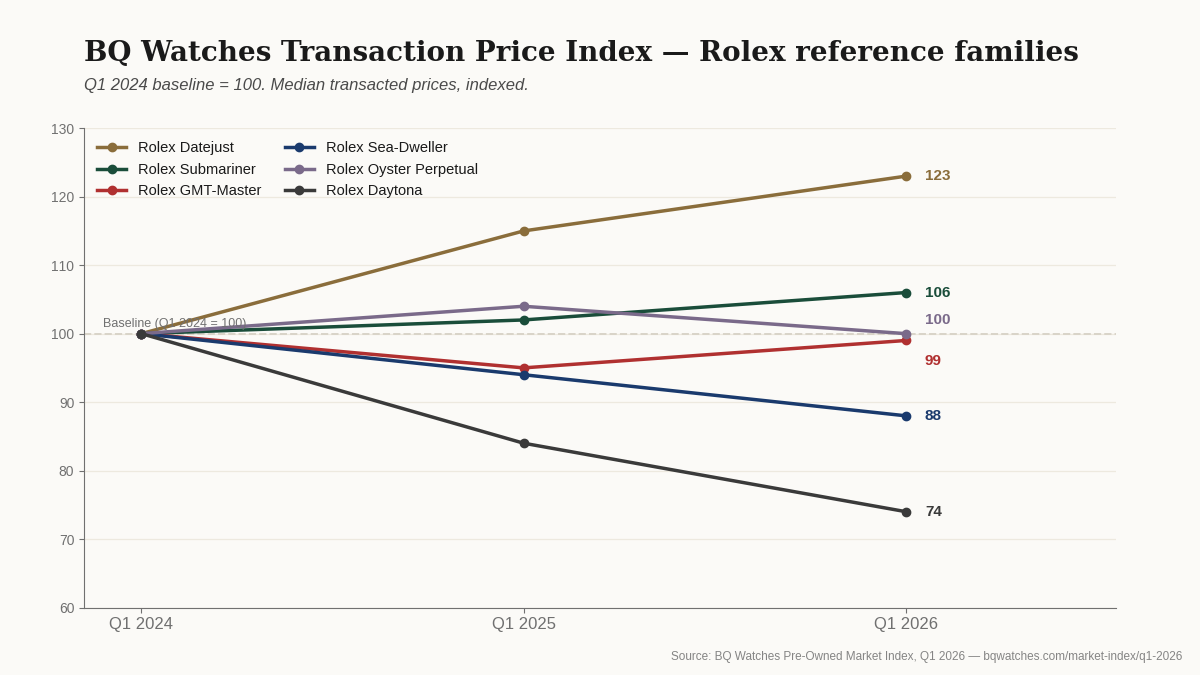
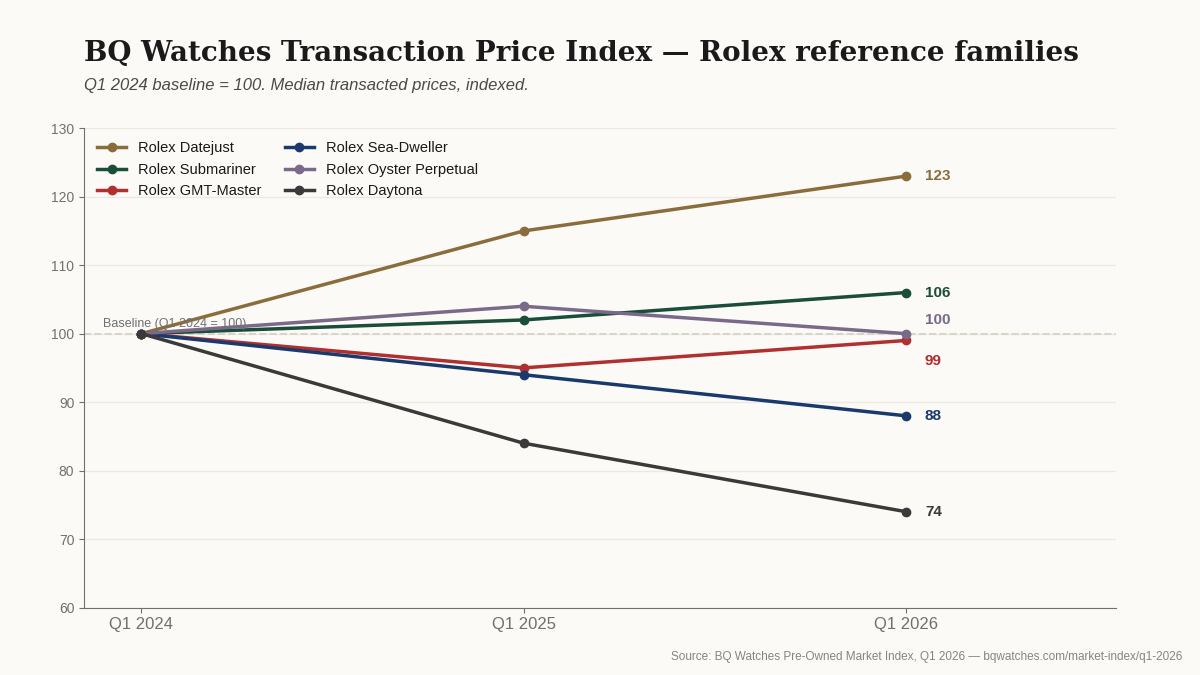
BQ Watches Transaction Price Index for six Rolex reference families across Q1 2024, Q1 2025 and Q1 2026, indexed against Q1 2024 = 100. Rolex Datejust rises to 123, Rolex Daytona falls to 74, others move within a 10-point band of the baseline.
Embed this chart

Copy the snippet below to embed this chart on another page. The chart is published under CC BY 4.0 — please retain the attribution link.

<p><a href="https://www.bqwatches.com/market-index/q1-2026"><img src="https://cdn.bqwatches.com/images/0383f212-0c95-4a0a-b72e-6c909b878256.png" alt="BQ Watches Transaction Price Index for six Rolex reference families across Q1 2024, Q1 2025 and Q1 2026, indexed against Q1 2024 = 100. Rolex Datejust rises to 123, Rolex Daytona falls to 74, others move within a 10-point band of the baseline." width="1200"></a><br><small>Source: <a href="https://www.bqwatches.com/market-index/q1-2026">BQ Watches Pre-Owned Market Index</a></small></p>
Download chart (PNG)

The line chart above shows the BQ Watches Transaction Price Index for the six Rolex reference families that met the suppression threshold across all three comparison quarters. The Q1 2024 baseline = 100; values above 100 represent transacted prices above the baseline median, values below 100 represent prices below it.

The Q1 2026 Transaction Price Index reveals a divided market at the family level. The Rolex Datejust's index of 123 represents the strongest sustained price movement of any of the major reference families across the two-year window, consistent with steady UK pre-owned demand for two-tone and steel Datejusts and a maturing buyer base across the family's broader catalogue. The Rolex Daytona's index of 74 reflects a material softening from the 2024 baseline, consistent with broader market commentary on the unwinding of the speculative Daytona premium that built across 2022 and 2023; the Sea-Dweller has followed a similar but milder trajectory. The Submariner, GMT-Master, and Oyster Perpetual have transacted broadly within a ten-index-point band of their 2024 baselines.

The Transaction Price Index is published only in quarterly and annual editions. The Q2 2026 quarterly edition will extend the series with a third comparison data point, supporting clearer trajectory commentary; the inaugural annual edition (covering full-year 2026, due February 2027) will introduce additional reference-level Transaction Price Index lines for the most-traded specific Rolex references.

Stock route composition, Q1 2026

The published stock-route composition dimension was introduced in the March 2026 monthly edition, enabled by a recent change to BQ Watches' transactional source data that flags whether each item was, at any point, held under consignment prior to its eventual sale. The flag is present from March 2026 onwards and was not present in the January 2026 or February 2026 source files.

For Q1 2026 as a whole, stock-route stratification is therefore limited to the March 2026 month, in which approximately 30% of completed sales involved consignment-route stock. The January 2026 and February 2026 stock-route composition is not reported. The Q2 2026 quarterly edition will publish stock-route composition across the full quarter; future quarterly editions will, where sample size permits the suppression threshold to be met within each route, publish stratified days-to-sell figures for consignment versus owned stock.

How customers are buying - the multi-year view

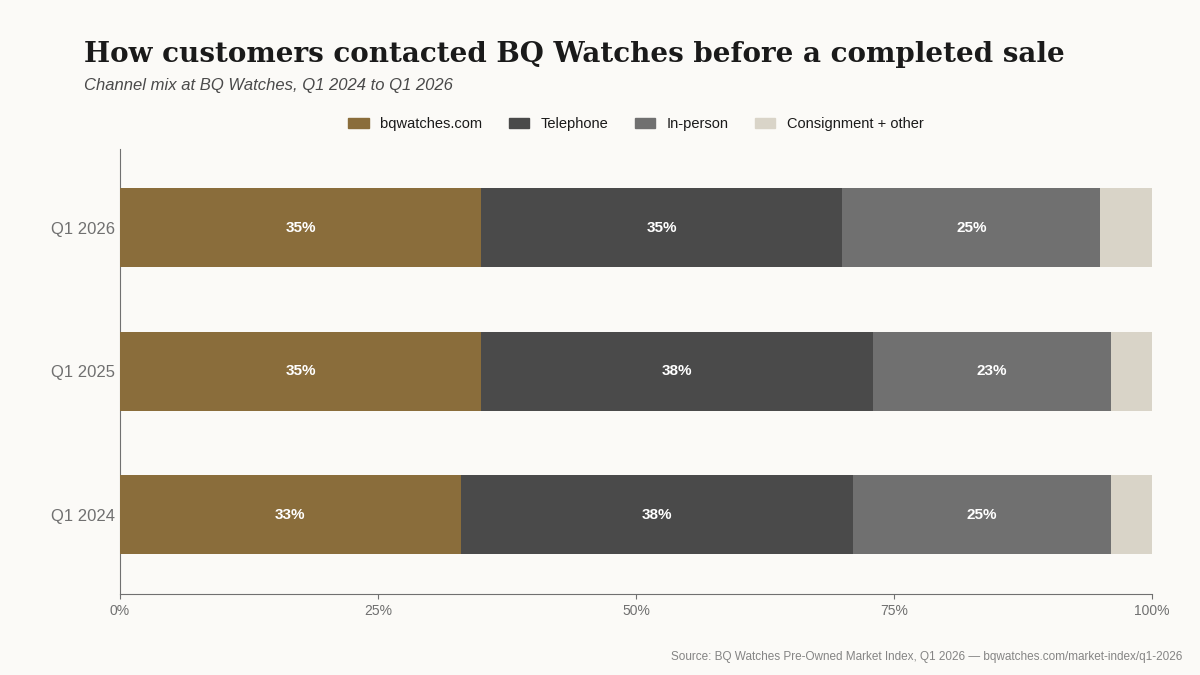
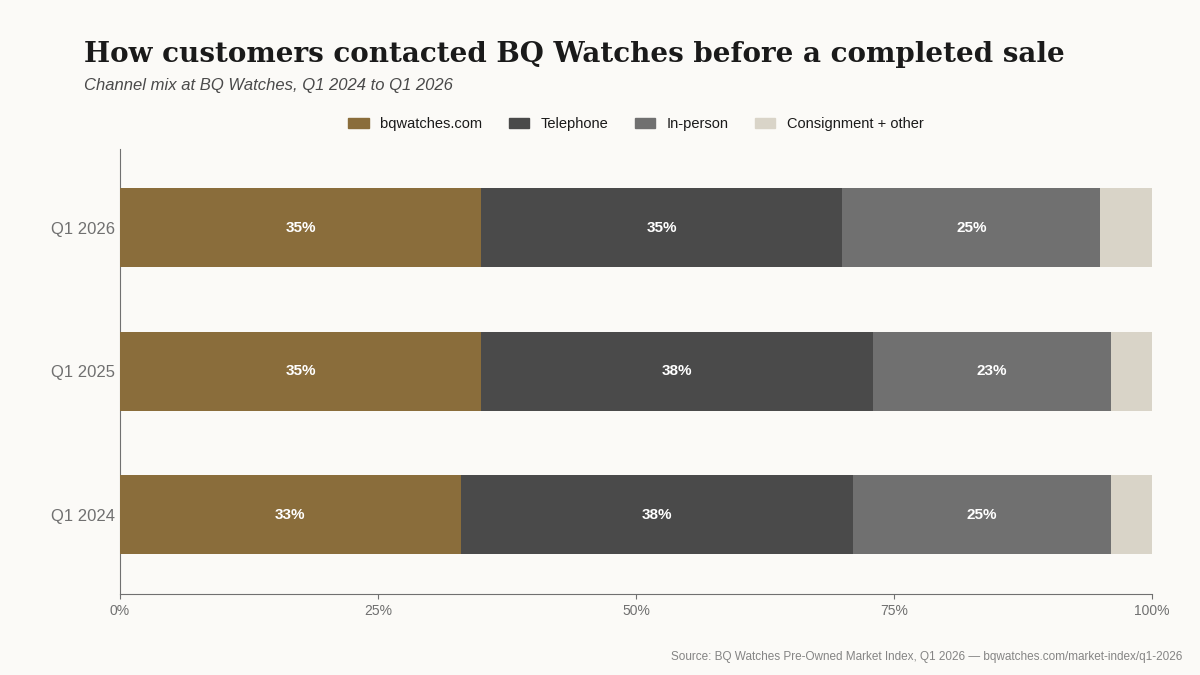
The quarterly resolution clarifies the longer-run channel-mix story that month-to-month volatility partially obscures. Across Q1 2026, the contact method through which a customer engaged BQ Watches before completing a sale broke down approximately as follows:

  • bqwatches.com (website enquiry forms, live chat and direct purchase): ~35%
  • Telephone enquiry: ~35%
  • In-person at the Radlett showroom or Hatton Garden viewing office: ~25%
  • Consignment and other arranged contact: ~5%

Compared to Q1 2025 (telephone ~38%, website ~35%, in-person ~23%) and Q1 2024 (telephone ~38%, website ~33%, in-person ~25%), the multi-year direction is a gradual rise in the website's share at the expense of the telephone, with in-person contact holding broadly stable across the three years. The single-month crossover reported in the January 2026 monthly edition — the first time the website overtook the telephone for completed sales in BQ Watches' record — was followed by partial reversal in February and March; at quarterly resolution, the two channels run at parity for the first time in any opening quarter.

Stacked bar chart showing the share of completed-sale customer contact methods at BQ Watches across Q1 2024, Q1 2025 and Q1 2026. bqwatches.com share rises from 33% to 35%; telephone falls from 38% to 35%; in-person and consignment shares are broadly stable.
Embed this chart

Copy the snippet below to embed this chart on another page. The chart is published under CC BY 4.0 — please retain the attribution link.

<p><a href="https://www.bqwatches.com/market-index/q1-2026"><img src="https://cdn.bqwatches.com/images/69b07328-4bea-456f-92b1-54d5d7a4d9d2.png" alt="Stacked bar chart showing the share of completed-sale customer contact methods at BQ Watches across Q1 2024, Q1 2025 and Q1 2026. bqwatches.com share rises from 33% to 35%; telephone falls from 38% to 35%; in-person and consignment shares are broadly stable." width="1200"></a><br><small>Source: <a href="https://www.bqwatches.com/market-index/q1-2026">BQ Watches Pre-Owned Market Index</a></small></p>
Download chart (PNG)

The stacked bars above show the proportional channel mix across the three opening quarters. bqwatches.com's share has crept upward at the telephone's expense; in-person engagement has held broadly stable; the consignment / other category is the smallest line.

From the buying desk: Spencer Dryer on Q1 2026

The following editorial commentary is contributed by Spencer Dryer, Managing Director, BQ Watches, who oversees buying and selling and provides the watch-market context that accompanies the index data.

The pace of Q1 2026 has been the most striking opening quarter of the past decade for me on the BQ Watches buying desk. Pre-owned Rolex turnover at BQ Watches has run at half its prior-year pace for three consecutive months. That is not noise. It is a genuine acceleration of UK buyer demand at the prevailing pre-owned price level, and it has been visible in the rate at which we are clearing inventory and replacing it from the trade and from private sellers.

Two specific observations the data alone does not fully capture.

First, the Rolex Datejust is performing differently from the sport models. The data shows the Datejust trading at index 123 across Q1 2026, the strongest reading among the major Rolex family lines in the Transaction Price Index. From the desk, what we are seeing is steady, broad-based UK demand for two-tone and steel Datejusts across the mid-tier of pre-owned pricing, with both the 36mm and 41mm cases moving well. The Datejust pattern is not a speculative spike. It is a story of underlying confidence in a versatile reference family. That is a healthier pattern than the sport-model bull-run of three years ago.

Second, the Rolex Daytona price softening is real but needs context. The Daytona's index reading at 74 in Q1 2026 partly reflects mix — we are transacting more of the standard ceramic-bezel references and fewer of the rare gem-set or vintage references that pulled the median upward in 2024. We are not seeing widespread distressed sellers. We are seeing a market normalising after a frenzy. The watches that are correcting most are the references that ran furthest above their official retail price in 2022 and 2023.

Looking forward into Q2 2026, I am watching three things: whether the Rolex GMT-Master's velocity holds against the "Pepsi"-driven hype cycle, whether Cartier consolidates further in the third brand position, and whether we begin to see months in which a generative-AI-attributed transaction is recurring rather than one-off. The first ChatGPT-attributed sale recorded in our March 2026 monthly edition was one transaction. By the time we publish the next quarterly edition, I expect we will be tracking a measurable share.

Methodology summary - quarterly edition

This first quarterly edition of the BQ Watches Pre-Owned Market Index pools transactional data from January, February and March 2026, with year-on-year comparisons against the equivalent pooled quarters in 2025 and 2024. All published metrics meet the BQ Watches Pre-Owned Market Index suppression threshold of at least ten observations per cell, applied uniformly across brand, family, channel, contact-method, reference and stock-route dimensions. The edition publishes share, rank, index and median figures only.

The BQ Watches Transaction Price Index is introduced in this edition. The index reports the median transacted sale price for each Rolex reference family that met the suppression threshold in each comparison quarter, indexed against the Q1 2024 baseline = 100. Median absolute prices underlying the index are not published; only the indexed values are reported. The Transaction Price Index will be extended in subsequent quarterly editions and elaborated to reference-level granularity in the inaugural annual edition.

Stock-route stratification across the full Q1 2026 quarter is not yet reported because the consignment flag was added to BQ Watches' transactional source data part-way through the quarter. The dimension is reported for March 2026 only in this edition; the Q2 2026 quarterly edition will publish full stratified figures.

For the full methodology, glossary, suppression rules, and standing series-level FAQ items, see the canonical methodology page: About the BQ Watches Pre-Owned Market Index.

Frequently asked questions about this edition

The BQ Watches Transaction Price Index reports the movement in median transacted sale prices for Rolex reference families at BQ Watches across comparable quarters, indexed against a Q1 2024 baseline = 100. It differs from major international indices such as the WatchCharts Overall Market Index and the Subdial Bloomberg Watch Index, which report movement in asking prices on listing platforms. Asking-price indices are valuable for understanding where the market is offering inventory; the Transaction Price Index reports where the UK pre-owned market is actually clearing transactions.

Two factors. First, market mix: BQ Watches is transacting more of the standard ceramic-bezel Daytona references in Q1 2026 and fewer of the rare gem-set or vintage references that pulled the Q1 2024 median upward. Second, broader market normalisation: the speculative premium that built on the Daytona across 2022 and 2023 has been unwinding through 2024, 2025 and into 2026, in line with commentary across the wider international watch press. The reading reflects both the changing reference mix and the softening of premiums.

The Datejust's index of 123 reflects steady, broad-based UK demand for the family across its 36mm and 41mm cases, in steel and two-tone configurations, at the mid-tier of pre-owned pricing. The Datejust is not a reference family that experienced a speculative bull-run in 2022 and 2023, so it has not had a premium to unwind. Its price trajectory across the two-year window is consistent with healthy underlying demand rather than the boom-and-bust pattern visible in the sport models.

The suppression threshold of ten observations per published cell rarely permits reference-level analysis at monthly resolution; at quarterly and annual resolution, the larger pooled sample supports it for the most-traded references. Reference-level findings are higher-effort to compile and benefit from the longer comparison window. The monthly editions are best suited to brand and family-level snapshots; quarterly and annual editions are where reference-level structural analysis becomes possible.

The Q2 2026 quarterly edition will follow the same structure, will extend the Transaction Price Index with a third comparison data point, and will publish stock-route stratified days-to-sell for the full quarter (not possible for Q1 2026 because the consignment flag was added mid-quarter). Where Q2 2026 also marks meaningful new data points - the first sustained generative-AI-attributed share above threshold, for example - those will be presented as new headline findings rather than slotted into the existing structure.

The monthly editions are point-in-time snapshots, published with a one-month lag. The quarterly edition pools the three months in the calendar quarter to support reference-level analysis, the Transaction Price Index, and the Liquidity Report at the deeper resolution that monthly samples cannot statistically support. Both are canonical: the monthly editions remain the source of record for their respective months, and the quarterly is the source of record for cross-month structural findings.

About this edition

Series editor: Simon Evans, CTO. Market commentary: Spencer Dryer, Managing Director. BQ Watches.

For the full methodology, glossary and standing FAQ, see the canonical methodology page.

Download the Q1 2026 aggregated metrics (CSV)

← Index hub