Black Friday 2025
Register now for early access to our exclusive Black Friday deals.
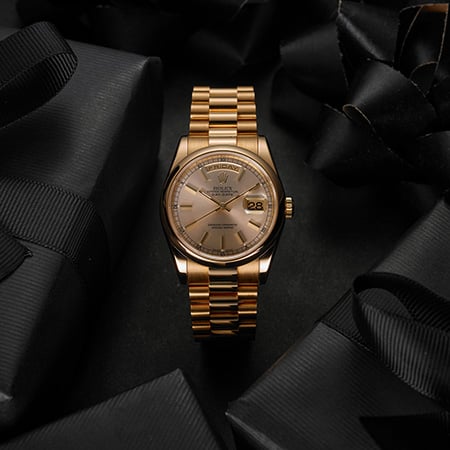
In one paragraph The Rolex Datejust reclaimed the top within-Rolex rank from the Rolex Submariner in May 2026, after the Submariner's first-time-in-series displacement of the Datejust in our April 2026 edition proved a single-month phenomenon. The all-Rolex median days-to-sell rose to 60 days from April's series-low 35 days, while remaining materially below the May 2025 reading of 102 days — a fifth consecutive month of year-on-year acceleration in pre-owned Rolex turnover at BQ Watches. In-person showroom contact normalised to approximately 25%, partially reversing April's series-high reading of approximately 35%.
The Rolex Datejust reclaimed the top within-Rolex rank from the Rolex Submariner. In our April 2026 edition, the Rolex Submariner had displaced the Rolex Datejust from the top within-Rolex rank for the first time in the index series. In May 2026, the Datejust returned to the top with approximately one in three Rolex transactions at BQ Watches, ahead of the Submariner at approximately one in four. The Submariner's April displacement is now confirmed as a single-month event rather than a sustained transition.
Pre-owned Rolex turnover sustained year-on-year acceleration into a fifth consecutive month, while moderating from April's series low. The all-Rolex median days-to-sell rose to 60 days in May 2026, against 102 days in May 2025, but is materially above April 2026's series-low reading of 35 days. The May 2026 figure represents a 41% year-on-year improvement against the May 2025 comparison, broadly in line with the multi-quarter trend, but the month-on-month rise from April suggests the acceleration is consolidating rather than continuing to deepen. Pre-owned Rolex turnover at BQ Watches has now run materially faster than its prior-year comparison for five consecutive months — the most sustained directional pattern in the index series to date.
In-person showroom contact normalised after April's series-high reading. In-person contact at the Radlett showroom and Hatton Garden viewing office accounted for approximately 25% of completed-sale contact in May 2026, compared to the series-high approximately 35% reported in our April 2026 edition. The April rebound, which the index had framed as resolving the in-person watch-list item in favour of resumed growth, is now better understood as a single-month spike. The longer-run direction-of-travel for in-person contact remains within the approximately 20-25% band recorded across most of the index series; April's reading is increasingly visible as an outlier.
Cartier held its top-three brand position at approximately 10%, ahead of Omega on unrounded share. Cartier accounted for approximately 10% of all transactions at BQ Watches in May 2026, the same share rounded to the nearest 5% as Omega. On unrounded share Cartier sat marginally ahead of Omega — the first month in the index series in which Cartier has appeared in the published mix above Omega. Cartier has now confirmed a top-three position across all five editions of the index series to date.
The Rolex Daytona returned below the suppression threshold after two consecutive months at threshold. The Daytona, which entered the index suppression threshold for the first time in our March 2026 edition and held threshold in April 2026, recorded fewer than ten transactions in May 2026 and is therefore aggregated within the "other Rolex" grouping for this edition. The two-month at-threshold run set in March and April is now the longest at-threshold streak the Daytona has recorded since the index series began.
The Rolex reference families that met the BQ Watches Pre-Owned Market Index suppression threshold in May 2026, ranked by transaction share within Rolex:
The Datejust reclaimed the top rank from the Submariner, which had held it briefly in April 2026; the Datejust has now held the top rank in four of the five editions of the index series to date. The Submariner retained second place. The GMT-Master held third. The Rolex Daytona, which had held a position at threshold in March and April 2026, fell below threshold in May 2026 and is aggregated within the "other Rolex" grouping for this edition. All other Rolex reference families also recorded transaction volumes below the suppression threshold individually in May 2026.
| Reference family | Median days-to-sell, May 2026 | Median days-to-sell, May 2025 | Direction |
|---|---|---|---|
| Rolex Submariner | 30 | 78 | Faster |
| Rolex GMT-Master | 39 | 69 | Faster |
| Rolex Datejust | 100 | 112 | Faster |
| All Rolex (combined) | 60 | 102 | Faster |
The all-Rolex picture continues the year-on-year acceleration trend that has now run for five consecutive months. At the family level, all three at-threshold families transacted faster than their May 2025 comparisons. The Submariner held its low days-to-sell rhythm broadly steady from April 2026, recording 30 days in May 2026 against 29 days in April. The GMT-Master, which recorded a series-record 16 days in April 2026, moderated to 39 days in May — still materially faster than its May 2025 reading of 69 days, but a meaningful reversion from the April series low. The Datejust transacted in May at a 100-day median, materially slower than the sports families but faster than its May 2025 comparison; the Datejust continues to operate on a distinctly different velocity profile from the sports families, as previously surfaced in the index.
Approximately 25% of completed sales at BQ Watches in May 2026 involved consignment-route stock, broadly in line with the approximately 25% reading in April 2026 and the approximately 30% reading in March 2026. The dimension is enabled by BQ Watches' transactional source data flagging whether each item was, at any point, held under consignment prior to its eventual sale; the flag has been present for March 2026 onwards.
Consignment-route stock: ~25% of May 2026 sales
Owned-stock route: ~75% of May 2026 sales
Stock-route composition has now run within an approximately 25-30% band across the three editions in which the dimension has been published, suggesting a stable structural feature of BQ Watches' transactional mix rather than a moving metric. The Q2 2026 quarterly edition will publish stratified days-to-sell figures across the consignment and owned routes for the first time, supporting cleaner like-for-like comparison than the all-stock readings can provide.
In May 2026, the contact method through which a customer engaged BQ Watches before completing a sale broke down approximately as follows:
Telephone enquiry: ~35%
bqwatches.com (website enquiry forms, live chat and direct purchase): ~35%
In-person at the Radlett showroom or Hatton Garden viewing office: ~25%
Consignment and other arranged contact: ~5%
The telephone-and-website readings remained within a percentage point of each other for the third consecutive month, sustaining the parity pattern observed across the spring 2026 editions. In-person contact moderated to approximately 25% after April's series-high reading of approximately 35%; the longer-run direction-of-travel for in-person contact at BQ Watches now appears to settle within an approximately 20-25% band, with April's reading visible as a single-month spike rather than a sustained shift. The May 2026 in-person reading is broadly consistent with the May 2025 reading of approximately 22%.
All published metrics in this May 2026 edition meet the BQ Watches Pre-Owned Market Index suppression threshold of at least ten observations per cell, applied uniformly across brand, family, channel, contact-method and stock-route dimensions. The edition publishes share, rank, index and median figures only; absolute revenue, absolute transaction counts and any margin-related metrics are excluded from publication.
For the full methodology, glossary, suppression rules, and standing series-level FAQ items, see the canonical methodology page: About the BQ Watches Pre-Owned Market Index.
Series editor: Simon Evans, CTO. Market commentary: Spencer Dryer, Managing Director. BQ Watches.
For the full methodology, glossary and standing FAQ, see the canonical methodology page.